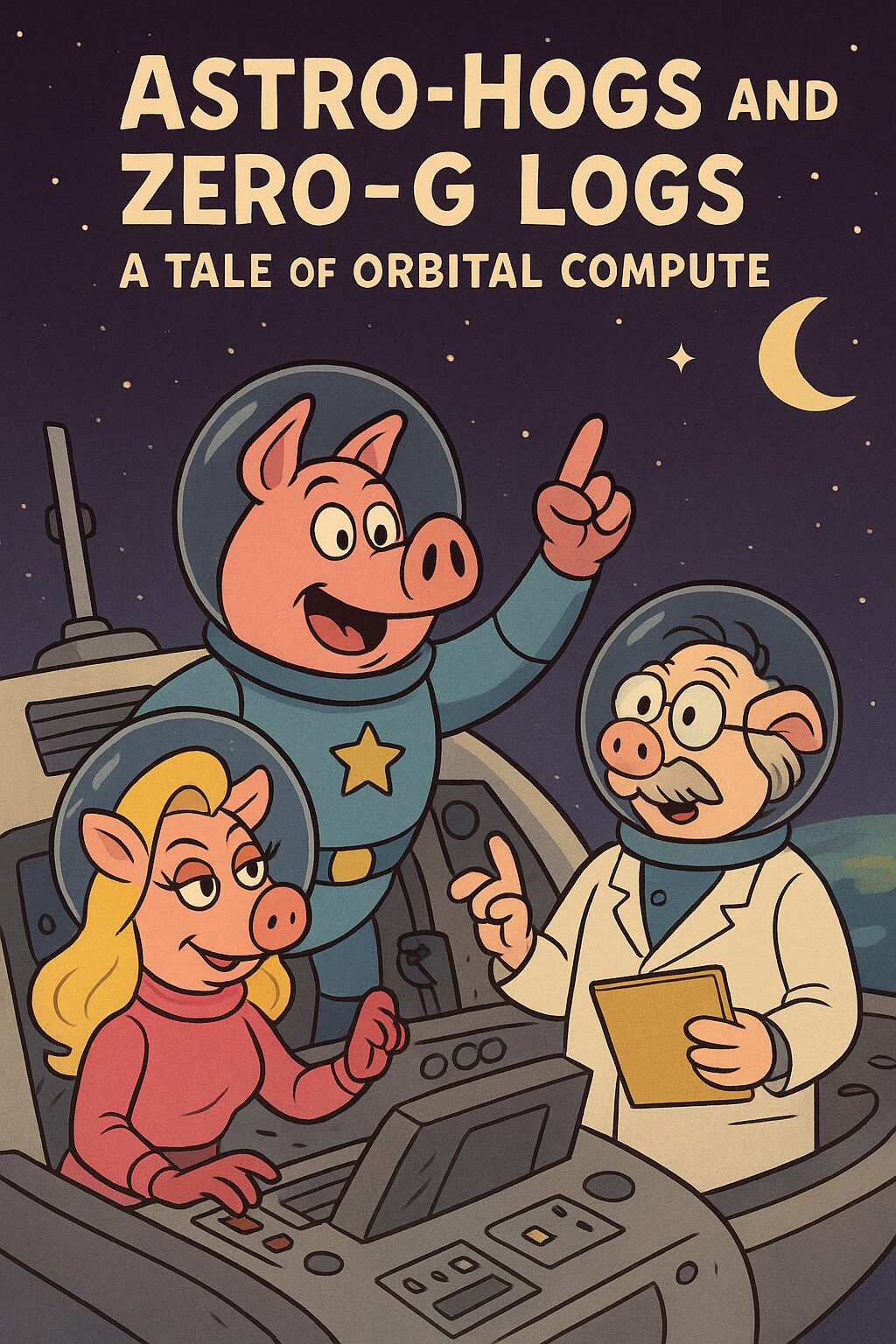
Astro-Hogs and Zero-G Logs: A Tale of Orbital Compute
Somewhere just above Earth’s atmosphere, far enough to avoid weather apps but close enough for suspiciously accurate pizza delivery, floats the Cosmic Compute Cruiser, humanity’s first attempt at putting a data center in space. Naturally, it’s staffed by a team whose qualifications are… let’s call them “interpretive.” Leading the pack is Captain Loin Hogstrom, a gloriously overconfident space pioneer whose idea of troubleshooting involves heroic posing and shouting at the servers until something reboots out of fear. By his side glides Lieutenant Prissy Porcaline, a zero-gravity glamour icon who somehow maintains perfect hair in vacuum conditions and insists that every quantum processor works better after a pep talk. Lurking in the background, as all good wild-card geniuses do, is Dr. Snoutzenstein, the ship’s technologist, inventor, and part-time existential threat. Together, they helm a star-faring data center powered by solar energy, unregulated optimism, and the occasional accidental explosion.
Their mission? Deploy orbital data centers so Earth’s power grid can finally take a nap from all that AI processing. Up here, cooling is simple,just fling open the radiant panels and pray Dr. Snoutzenstein hasn’t tried to repurpose them as “experimental wings” again. The benefits are enormous: endless sunlight, a vacuum perfect for dumping heat, and absolutely zero raccoons chewing on cables (a real problem, according to Porcaline’s last performance review). Even so, the crew faces unique challenges, like the time Captain Hogstrom discovered that every server was accidentally installed in “demo mode,” forcing them to listen to a polite but relentless robotic voice announcing, “THANK YOU FOR TRYING THE FREE VERSION!” every 12 minutes. Porcaline responded by spinning gracefully across the cabin and pulling off a triple-axel reset maneuver, proving once and for all that space engineering is 40% skill and 60% acrobatics.
And yet, despite the chaos, there’s something wondrous about it all. When the Cosmic Compute Cruiser glides over the curve of the blue planet, its servers humming like a mechanical choir and its radiators glowing like celestial lanterns, even the crew goes quiet. For a moment, right before Dr. Snoutzenstein sets something on fire again, they marvel at a future where humanity’s greatest computations float among the stars. It’s a future full of ambition, cosmic possibility, and just enough absurdity to keep things interesting.
Will orbital compute transform the world? Probably. Should anyone trust this crew with it? Absolutely not. But they’ll be up there anyway, snorting, soaring, and logging zero-G data one cosmic mishap at a time.
Reference:
https://www.datacenterdynamics.com/en/analysis/the-ai-power-swingers