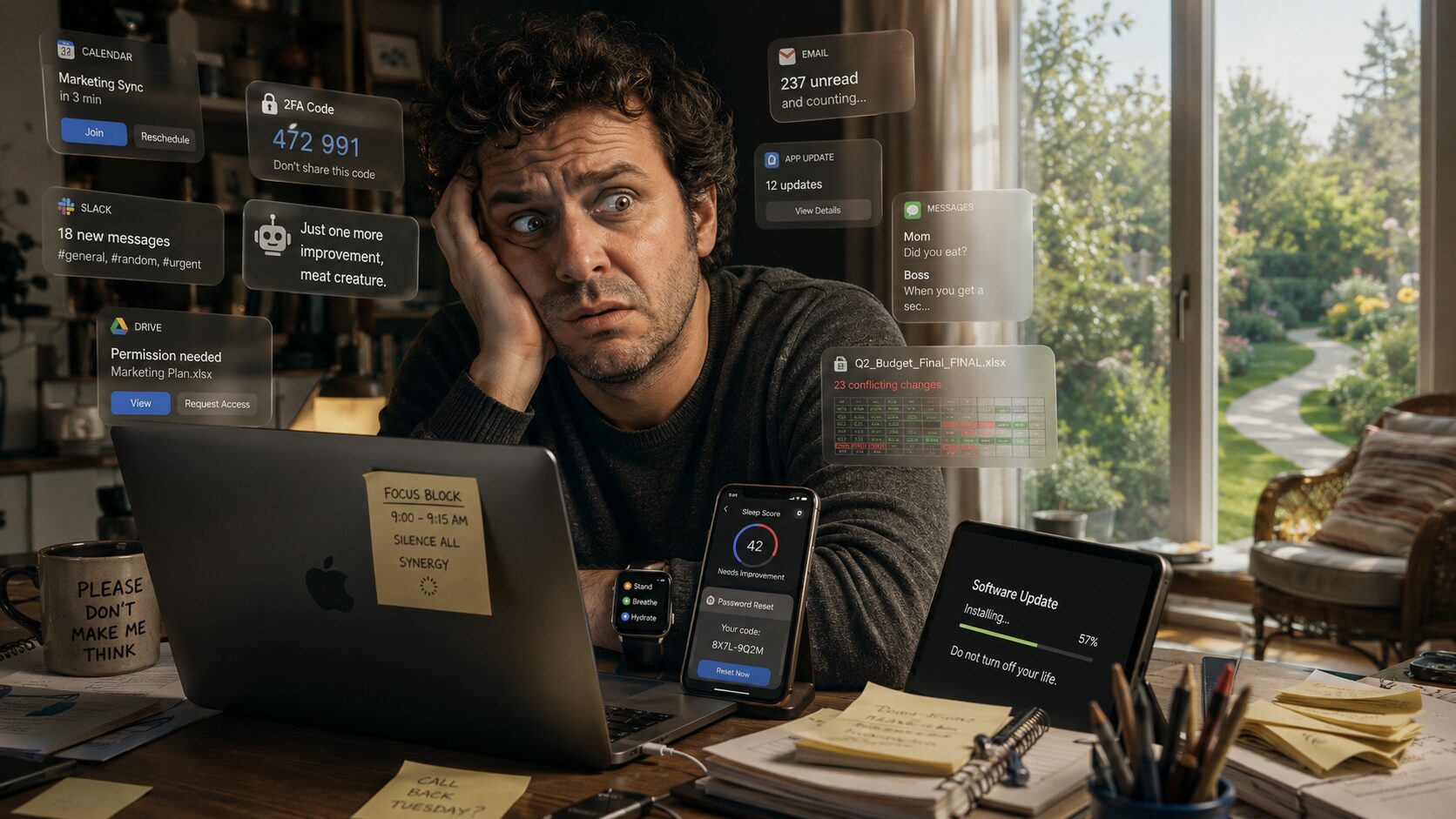
Set Boundaries and Reclaim Your Time from Notification Overwhelm:
Your workstation does not want to power on due to embarrassment. Your phone wants to optimize your sleep. Your watch wants you to stand up, breathe deeper, drink water, close rings, open rings, achieve rings, become one with the ring-based economy, and confirm that yes, you are stable. Somewhere, an AI assistant is analyzing you, your calendar, and the suspicious gaps between meetings, concluding that the problem with your life is insufficient “focus blocks,” which is adorable, because the actual problem is that every device you own has become a tiny glowing middle manager with boundary issues.
Are we no longer people? Or are we just damp biological docking stations for notifications? The feed feeds, the pings ping, the cloud syncs, the spreadsheet has achieved legal overview, and Co-whatever would like you to acknowledge its suggestions before it emotionally escalates. Meanwhile, the algorithm leans in close and whispers, “Just one more improvement, meat creature. We call it optimization because the voluntary AI hamster wheel tested poorly with investors.” Every app promises to save us time, then immediately demands a password reset, a verification code, a software update, a preference survey, and permission to know our precise location while we are trying to buy socks.
So here is the counter-revolution: do less, badly, on purpose. Stare out a window for ten minutes like a Victorian ghost with no monetization strategy. Talk to a stranger without checking their profile first. Let an email age in the inbox until it develops character. The future may be friction-less, automated, and available in beta or production, but you, glorious puny human, are allowed to be slow. The funniest skill left is not mastering the machine. It is making the machine wait while you remember you have a spine, a sky, and no urgent need to become firmware.